Astronomers mosaic-imaged a giant molecular filament using ALMA to reveal, for the first time, the early mass assembly history during clustered star formation in a single cloud.
The study focuses on a central question in star formation: how massive stars and stellar clusters assemble their mass over time? To tackle this problem, astronomers have long focused on deeply embedded “infant” stars that remain hidden within cold molecular clouds. These objects are invisible at optical wavelengths but radiate strongly at (sub-)millimeter and radio wavelengths due to their low temperatures. Over the past decades, large Galactic surveys have significantly expanded the sample of star-forming regions across diverse environments and distances. However, this diversity has also introduced substantial environmental variations, complicating efforts to isolate evolutionary effects from external influences.
The G316.8 filament provides a rare controlled laboratory. This 14-parsec-long, nearly linear molecular structure contains three adjacent subregions with comparable gas reservoirs (about 10,000 solar masses each), yet spanning a clear evolutionary sequence — from an infrared dark cloud to an evolved H II region. As part of the LANCET (Linear filament and nested cluster evolution tomography) project, Xu and collaborators mapped the entire filament using 118 ACA pointings at 1.3 mm with the Atacama Compact Array. By combining interferometric data with complementary single-dish observations, the team reconstructed high-resolution temperature and column density maps across the full 14-parsec extent. This multi-scale approach enabled a systematic comparison of gas fragmentation and dense structure formation along the evolutionary sequence.
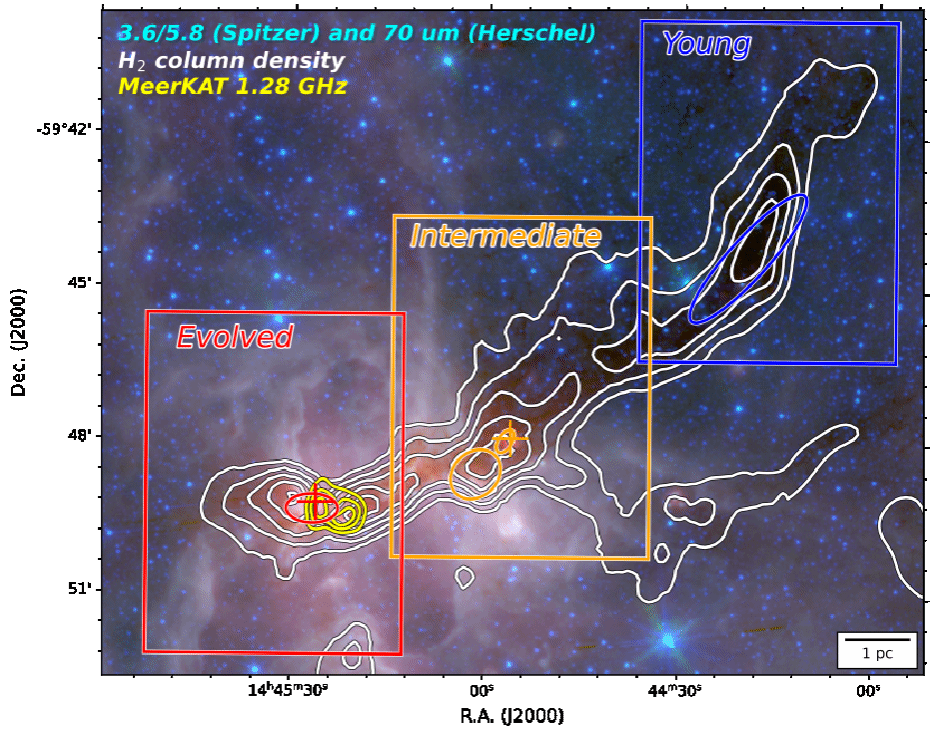
Figure 1. Overview of G316.8 filament. Background color map composites of Spitzer 3.6 and 5.8 µm and Herschel 70um images. The overlaid white contours show the molecular hydrogen column density map with levels of 3.0, 5.0, 8.0, 12.6, and 20.0 × 1022 cm−2. The blue, orange, and red boxes outline the young, intermediate, and evolved evolutionary parts, respectively. Massive clumps embedded in each part are shown with color ellipses.
To characterize the internal structural differences among the three subregions, the team adopted three independent statistical methods. First, they analyzed the column density probability distribution function (N-PDF), which quantifies how gas is distributed across different density levels. In molecular clouds, the N-PDF typically consists of a log-normal component — shaped by turbulence — and one or more power-law tails associated with gravitational collapse. From the quiescent to the actively star-forming regions, the log-normal component becomes progressively broader, likely reflecting enhanced turbulent motions (see Figure 2, left panel). In the most evolved region, a second power-law tail emerges, indicating that an increasing fraction of gas has been converted into dense structures capable of forming stars. The evolution of the N-PDF therefore provides a quantitative signature of dynamic mass assembly.
Second, the team examined scale-dependent structure using the delta-variance method, which measures how structural power is distributed across physical scales. As shown in the middle panel of Figure 2, the youngest region exhibits the steepest delta-variance slope, indicating a dominance of large-scale structure and relatively little small-scale concentration. In the intermediate region, the slope becomes shallower, signaling the emergence of smaller-scale fragmentation. The evolved region shows enhanced structural power at small scales, consistent with the presence of compact cores and clustered star formation.
As an independent diagnostic, the researchers also applied dendrogram analysis to extract hierarchical structures. The right panel of Figure 2 reveals that more evolved regions contain a larger number of hierarchical “branches” and nested substructures, whereas the youngest region is characterized by more isolated and less developed structures. Together, these scale-dependent analyses demonstrate a systematic reorganization of gas from large-scale filamentary structure toward small-scale concentration.
“Taken together, these three lines of evidence — N-PDF evolution, delta-variance scaling, and hierarchical morphology — paint a coherent picture of time-sequenced structural transformation within a single molecular filament,” said Xu. “The first results from LANCET provide one of the clearest observational demonstrations that massive cluster formation proceeds through progressive gas concentration and hierarchical reorganization, rather than being predetermined solely by the initial mass reservoir. This is benefited from our well-designed ALMA observation strategy. More is yet to come!” Prof. Wang added.
The LANCET team has recently obtained new Atacama Large Millimeter/submillimeter Array (ALMA) observations with nearly ten times higher physical resolution (down to 1000 AU). They have also acquired spectral line data to probe gas kinematics and full-polarization observations to measure magnetic fields in G316.8.
“The first ‘cut’ of LANCET dissects the global density structure,” said Xu. “Future observations will enable a deeper, multi-messenger tomography of how mass flows, fragments, and ultimately builds massive stellar clusters.”
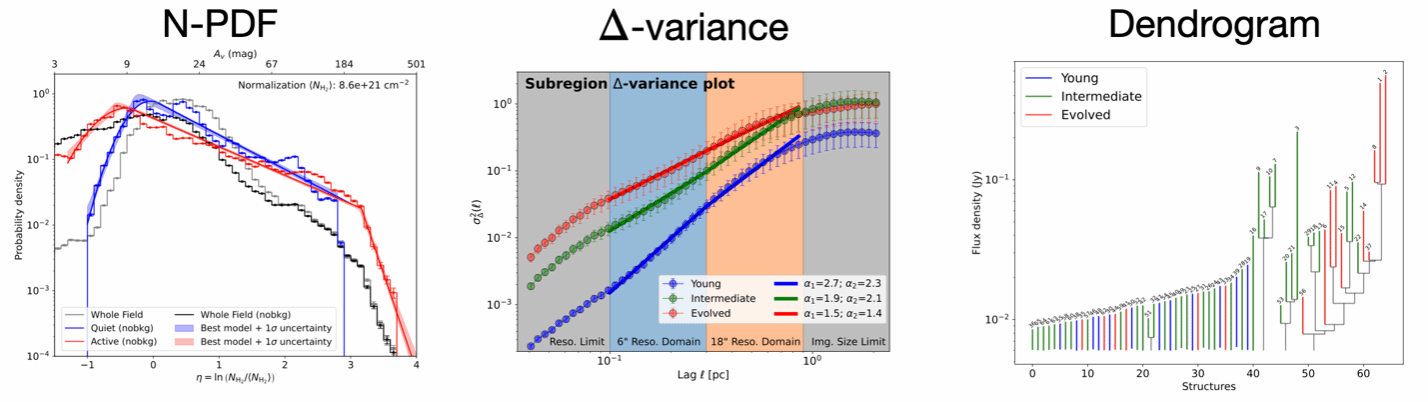
Figure 2. Regional differences from quiescent to active star-forming regions. Left: Column density probability distribution function (N-PDF) develops a slightly flatter first power-law tail and an additional, steeper secondary tail. Middle: The ∆-variance slope becomes progressively shallower. Right: The dendrogram shows more hierarchical structures are found in more active regions.
The study (Xu et al. 2026, A&A, 708, A251) is led by Dr. Fengwei Xu, a recent PhD graduate of the Kavli Institute for Astronomy and Astrophysics (KIAA) at Peking University and currently a postdoctoral fellow at the Max Planck Institute for Astronomy (MPIA) in Heidelberg, Germany, and his PhD supervisor Prof. Ke Wang. LANCET was initiated during Xu’s doctoral research, and is a follow-up of Prof. Ke Wang’s recent release of the Milky Way atlas for linear filaments (Wang et al. 2024, A&A, 686, L11).
Article links:
https://doi.org/10.1051/0004-6361/202557480
Linear filament and nested cluster evolution tomography (LANCET) I. Capture the evolution of dense gas in 14-parsec filament G316.8
https://doi.org/10.1051/0004-6361/202450296
The Milky Way atlas for linear filaments
