The High-energy Transients Follow-up (HiTF) Group reported their first scientific observation via the General Coordinates Network, based on data obtained with the PKU 60-cm Telescope. The report, led by Yacheng Kang, a PhD student in Prof. Lijing Shao’s group, presents optical follow-up photometric observations of a peculiar gamma-ray burst detected on March 10 by the Fermi Gamma-ray Space Telescope. Although this was not the first GCN report on the event, the HiTF Group responded promptly to the global call for coordinated multi-site follow-up observations, providing valuable support for continued monitoring. This effort marks an important step for PKU astronomy to independently conduct follow-up observations.
“Transients” refer to astronomical phenomena that emerge suddenly, evolve rapidly, and often fade on short timescales. High-cadence, multi-instrument observations of such rapidly changing events typically rely on coordinated worldwide efforts across many research teams. This report demonstrates that PKU is now contributing to the efforts to characterize newly emerged transients.
The PKU 60-cm Telescope, completed and commissioned in November 2023 at the Xinglong Observatory of the National Astronomical Observatories, Chinese Academy of Sciences, is independently operated by the Department of Astronomy at PKU. Although it primarily serves remote teaching and training purposes, the telescope also provides research-grade observational capabilities. The PKU 60-cm Telescope is already capable of supporting research-level optical follow-up observations of high-energy transients, including gamma ray bursts, fast X-ray transients, and tidal disruption events. In contrast, the 40-cm telescope on the PKU Yanyuan Campus is largely restricted to teaching use due to urban observing conditions. The new capabilities will enhance the scientific use of existing observational resources, including for students participating in domestic and international research programs in transients.
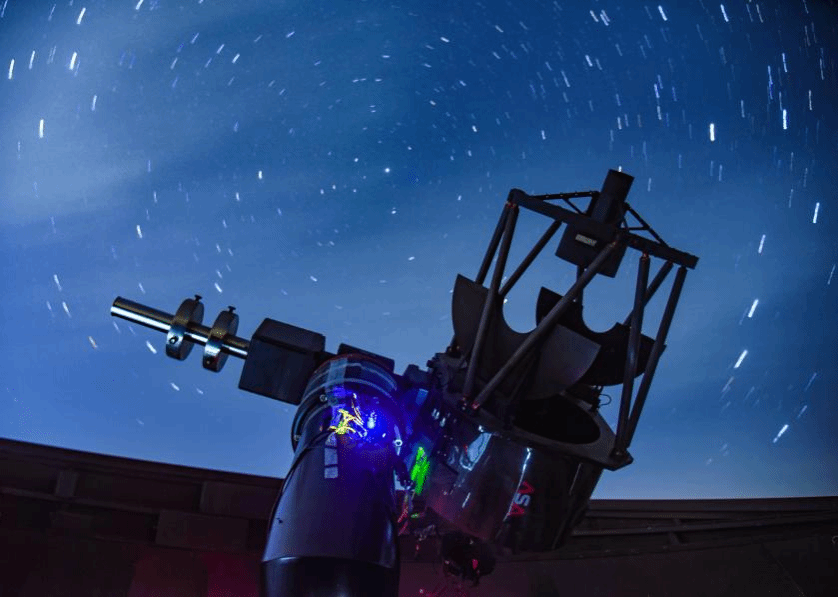
The PKU 60cm Telescope
(©DoA, PKU)
The core members of the PKU HiTF group consist of PhD and undergraduate students, established with the support and encouragement of faculty members from the DoA and the Kavli Institute for Astronomy and Astrophysics at PKU. The team independently conducts observations, reduces data, and issues GCN notices. In addition to observations with the PKU 60-cm Telescope, the group has collaborated with the Interestar Collaboration, initiated by Zhuokai Liu, a PhD student at PKU, to integrate multiple commercially available amateur telescopes across both hemispheres. This effort has begun to establish a global follow-up network enabling coordinated multi-site observations and rapid response to high-energy transients.
With the rapid development of multi-messenger astronomy, transient observations are entering a new phase, increasingly driven by large data volumes and coordinated efforts. A notable example is the binary neutron star merger event GW170817 in 2017, for which the optical counterpart following the gravitational-wave trigger was discovered with the 1-m Swope telescope in Chile. Subsequent independent confirmations by other small- and medium-aperture telescopes significantly refined the identification, enabling detailed follow-up studies with larger facilities. This example highlights the critical role of coordinated, multi-site, multi-instrument, and multi-wavelength observations in capturing the temporal evolution of transients. With the deployment of high-energy missions such as Einstein Probe (EP) and the Space-based multi-band astronomical Variable Objects Monitor (SVOM), as well as some ground-based large-scale facilities such as the Vera C. Rubin Observatory, the rate of transient alerts is increasing rapidly. Consequently, the development of efficient and flexible follow-up networks has become essential for advancing time-domain and multi-messenger astrophysics.
Looking ahead, the HiTF Group will continue to refine its observational and data-processing framework, expand its multi-wavelength coordination capabilities, and contribute to the systematic study of high-energy transient sources. As noted by Brian Schmidt, one of the laureates of the 2011 Nobel Prize in Physics, “While an individual study may represent only a small contribution, the accumulation of many such efforts ultimately helps to reveal the broader picture of the Universe.” In this context, the work of the PKU HiTF Group represents one such contribution to the field.
Compilation of GCN notices by the PKU HiTF Group:
https://ui.adsabs.harvard.edu/user/libraries/i6zbBBsiTq-ECVzd5GpuIQ(continuously updated)
