Astronomers have long debated whether our Milky Way galaxy and its massive neighbor, Andromeda (M31), will eventually merge into a single galaxy in the distant future. Using improved dynamical measurements, PhD student Hao Wu and Professor Huawei Zhang in the Department of Astronomy at Peking University led a team of astronomers to determine that the probability of a merger between the Milky Way and Andromeda is 90% within the next 10 billion years.
Andromeda is the nearest massive spiral galaxy to the Milky Way, located about 2.5 million light-years away. Over a century ago, spectroscopic observations revealed that the “Andromeda Nebula” is moving toward the Milky Way at 110 km/s. Whether this motion leads to a collision depends on Andromeda’s transverse (sideways) motion relative to the Milky Way. Although previous evidence was contradictory, the team resolved these discrepancies using improved stellar samples, showing that a merger is likely in about 6.5 billion years. At that time, these two dominant members of the Local Group of galaxies will gradually coalesce into a new giant elliptical galaxy, often referred to as “Milkomeda.”
Constructing Improved Stellar Samples to Resolve the Controversy
Early measurements from the Hubble Space Telescope (HST) yielded a slow transverse velocity of 17 km/s for M31 relative to the Milky Way. At this velocity, the two galaxies would inevitably encounter each other within several billion years and eventually merge in about 5.5 billion years. However, high-precision astrometric measurements from the Gaia Telescope produced much higher transverse velocities. Estimates derived from different stellar samples varied substantially: transverse velocities inferred from blue and red samples differed by about 200 km/s, and even the blue-sample result, closer to the HST value, yielded a transverse velocity of about 80 km/s.
Using the Gaia results, Sawala et al. (2025) in Nature Astronomy suggested that the probability of a Milky Way–M31 merger within the next 10 billion years might be only about 50%. The HST-based estimate was limited by its relatively small field of view and model-dependent corrections for internal motions, while Gaia-based measurements suffered from significant sample-selection effects. Consequently, observational constraints on M31’s transverse velocity remained highly uncertain, and the ultimate fate of the Milky Way–M31 system was far from settled.
Wu, Zhang, and their collaborators constructed high-quality samples of supergiant stars in Andromeda and the nearby Triangulum Galaxy (M33) using large-scale spectroscopic data from the Large Sky Area Multi-Object Fiber Spectroscopic Telescope (LAMOST). Owing to their intrinsically high luminosities, supergiant stars are among the most readily observable stellar populations in nearby galaxies and thus serve as ideal tracers for measuring proper motions. The team first selected supergiant candidates likely associated with M31 and M33 based on photometric criteria from the Local Group Galaxies Survey (LGGS) and Gaia data. They then combined radial velocity measurements from LAMOST with Gaia’s high-precision astrometry to effectively remove contamination from Galactic foreground stars.
In total, they identified 199 supergiant members in M31 and 84 in M33, with sample purity improved by at least an order of magnitude compared to previous work. Based on their spatial distribution, they further uncovered possible substructures in the northeastern and southwestern regions of M31. This work expands the spectroscopically confirmed supergiant sample by approximately 30%, providing not only a valuable basis for studying the evolution of massive stars in nearby galaxies but also cleaner, more reliable tracers for subsequent high-precision kinematic measurements.
Resolving the Key Discrepancy in Gaia Proper Motion Measurements
Using the constructed supergiant samples, the astronomers reassessed the key question of whether the Milky Way and M31 will eventually merge. They then constructed the rotation curve of the M31 disk to remove the effect of internal motions on the measured bulk proper motion of the galaxy.
Their analysis showed that the previously reported sample dependence in Gaia measurements mainly originated from systematic differences between the five-parameter and six-parameter astrometric solutions in Gaia DR3. Compared with the five-parameter solutions, the six-parameter solutions are less precise and exhibit significant systematic offsets. The red sample was dominated by six-parameter solutions, whereas the blue sample contained a much higher fraction of five-parameter solutions. By excluding extremely red sources and using background quasars to calibrate the proper motion zero-point offsets separately for samples with the five- and six-parameter solutions, the team successfully brought the blue and red sample results into agreement within the 1σ level, thereby resolving this long-standing issue.
Finally, based on the sample stars with high-precision five-parameter solutions, the team obtained a more robust and precise measurement of M31’s proper motion, corresponding to a transverse velocity of 46.7 ± 24.0 km/s relative to the Milky Way. Applying the same method to M33, they also obtained a precise proper motion measurement supporting the picture in which M33 is currently on its first infall into M31’s gravitational potential. This work clarified the motions of both M31 and M33 and laid a solid foundation for assessing the fate of the Milky Way–M31 system.
Future Outlook and Implications
To determine whether Milkomeda is in our future, the researchers reassessed the future dynamical evolution of the MW–M31 system by adopting a four-body semi-analytic model including the MW, M31, the Large Magellanic Cloud (LMC), and M33. Within the observational constraints and their uncertainties, they performed 10,000 Monte Carlo realizations of the initial conditions, sampling the masses, distances, proper motions, and radial velocities of each galaxy, and numerically integrated the corresponding future orbits. The results show that, in the fiducial model, the probability of a MW–M31 merger within the next 10 Gyr is approximately 90% (see Figure 4), with a median merger time of about 6.5 Gyr. This finding largely restores the classical picture in which the MW will eventually merge with M31.
More importantly, the study shows that even small changes in M31’s proper motion can significantly alter the future orbital evolution of the Milky Way–M31 system. On one hand, M31’s proper motion directly determines the balance between the radial and tangential components of the relative motion. On the other hand, by changing the orientation of the orbital plane, it also affects how the reflex motions induced by the Large Magellanic Cloud (LMC) and M33 are projected onto that plane, thereby either promoting or suppressing the final merger. Thus, different measurements of M31’s proper motion can lead to different conclusions regarding the system’s future evolution.
The study also notes that, although the current results support the picture in which the Milky Way and M31 will ultimately merge, the question remains inconclusive. Within the current measurement uncertainties, the merger probability may still range from 64.7% to 100% within the 2σ interval. To determine more precisely whether the two galaxies are destined to collide, the uncertainty in M31’s proper motion will need to be reduced to about 2 μas/yr. This conclusion provides an important reference for the design and optimization of relevant science goals for the forthcoming China Space Station Telescope (CSST).
From the systematic identification of supergiant samples, through resolving discrepancies in M31’s proper motion measurements, to reassessing the fate of the Milky Way–M31 system, the team has advanced our understanding of a central dynamical problem in the Local Group through a series of studies. This work not only clarifies the motions of M31 and M33 but also provides a solid foundation for understanding the long-term dynamical evolution of the Milky Way and other massive galaxies in the Local Group.
The first author of the related papers is Hao Wu, a PhD student in the Department of Astronomy at Peking University. The corresponding authors are Associate Professor Yang Huang of the University of Chinese Academy of Sciences and Professor Huawei Zhang in the Department of Astronomy at Peking University. The works have been published in Research in Astronomy and Astrophysics (Wu et al. 2025a, RAA, 25, 015012), Astronomy & Astrophysics (Wu et al. 2025b, A&A, 701, A265), and The Astrophysical Journal Letters (Wu et al. 2026, ApJL, 1001, L19). These studies were supported by the National Natural Science Foundation of China, the National Key R&D Program of China, and additional funding sources.
Related Papers:
https://iopscience.iop.org/article/10.1088/1674-4527/ad9197
https://www.aanda.org/articles/aa/full_html/2025/09/aa55477-25
https://iopscience.iop.org/article/10.3847/2041-8213/ae5799
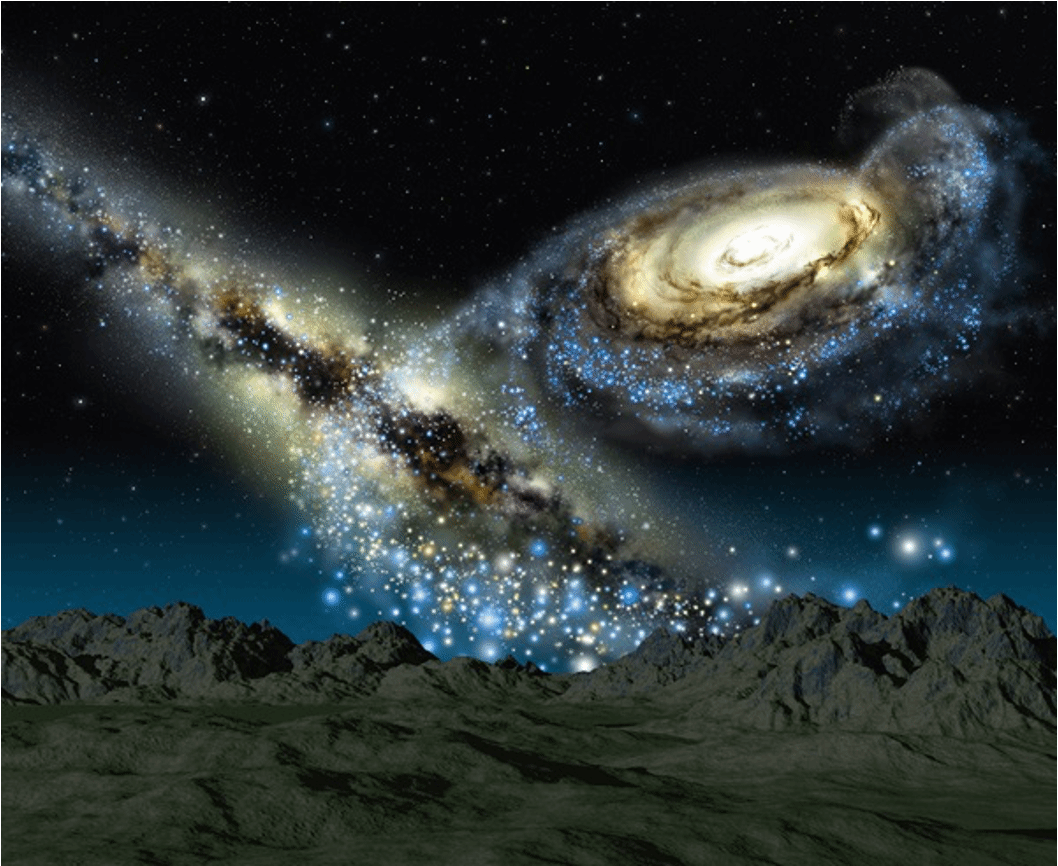
Figure 1. An artist’s impression of the merger between the Milky Way and the Andromeda galaxy. Following the merger, the two galaxies are expected to evolve into a giant elliptical galaxy, often referred to as “Milkomeda”.
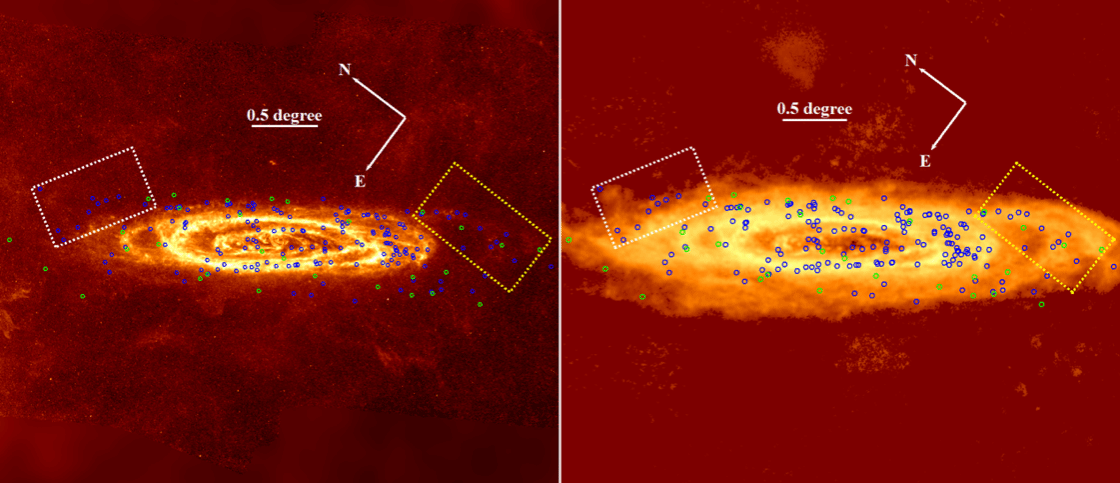
Figure 2. Spatial distribution of supergiant candidates in M31. Blue circles indicate the positions of “Rank 1” supergiant candidates, and green circles indicate those of “Rank 2” candidates. The white and yellow dashed boxes mark possible substructures in the northeastern and southwestern corners of M31, respectively. The left panel is based on a Herschel SPIRE 250 μm map, and the right panel is based on an HI 21 cm map.
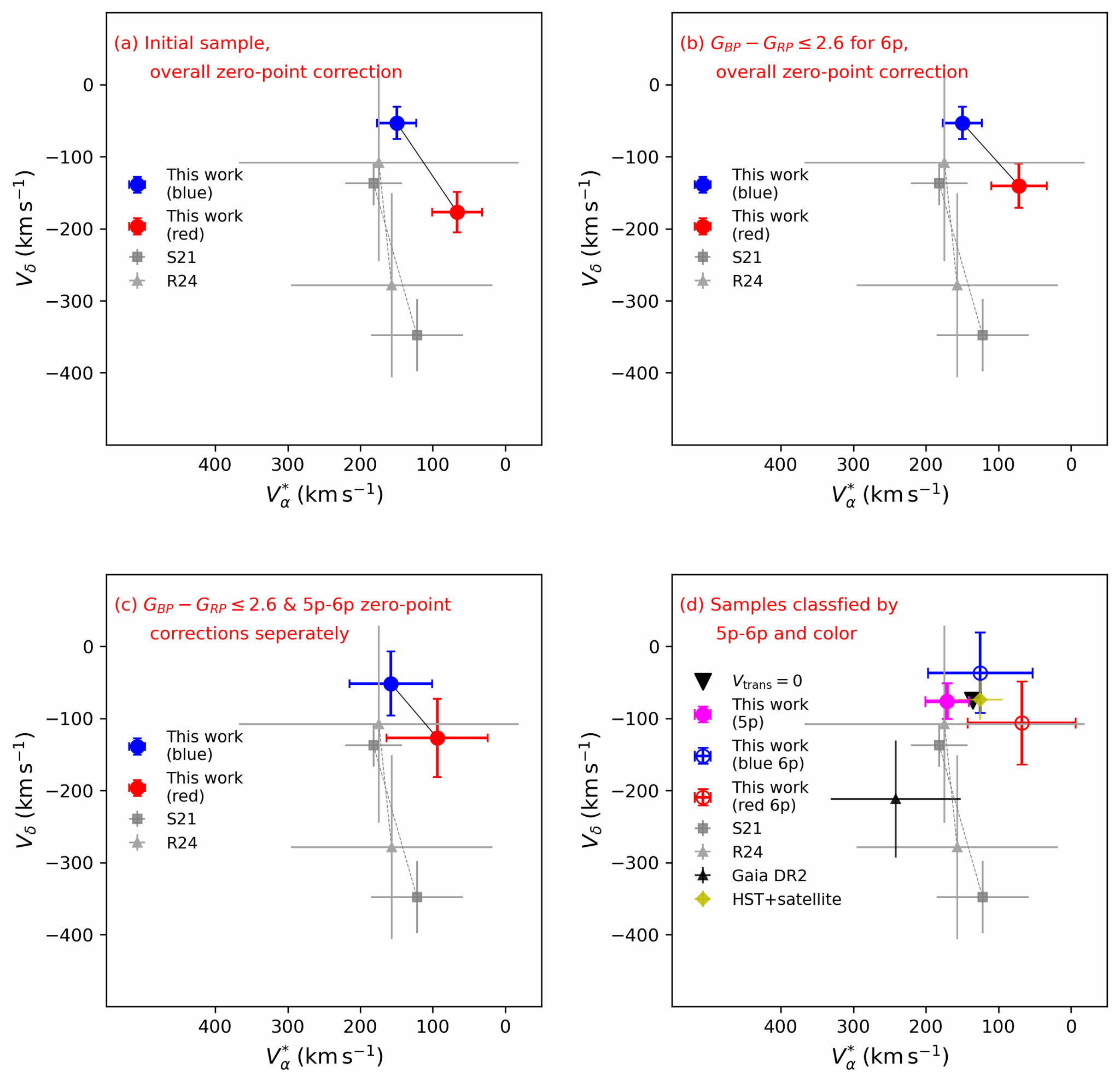
Figure 3. The procedure of resolving the discrepancy between blue and red sample proper motion measurements of M31 based on Gaia DR3. Panels (a)–(c) present the proper motion measurements for the blue and red samples in this work and compare them with previous results based on Gaia (E)DR3. As shown in panel (c), after two correction steps, the blue and red sample measurements become consistent within 1σ. Panel (d) shows the overall comparison between the final result of this work and previous measurements from HST, Gaia DR2, and Gaia (E)DR3. The magenta symbol denotes the recommended result based on stars with high-precision five-parameter astrometric solutions.
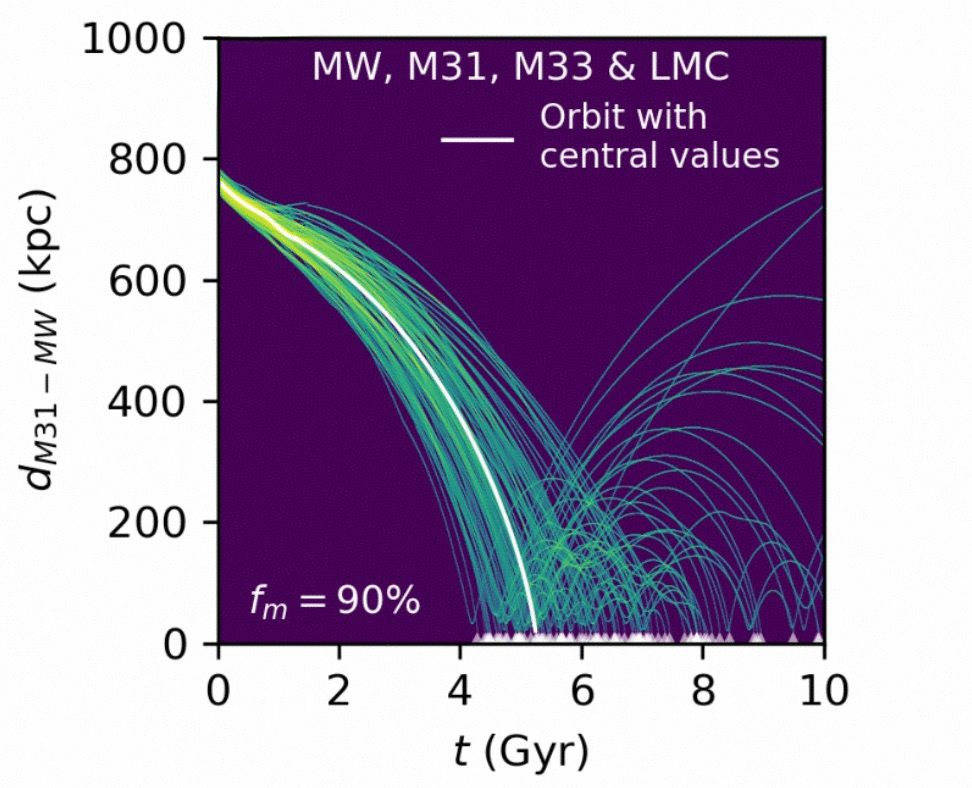
Figure 4. Orbital evolution of the Milky Way–Andromeda system. The time evolution of the Milky Way–M31 separation is shown for 100 randomly selected Monte Carlo realizations in a four-body model including the Milky Way (MW), Andromeda (M31), Triangulum (M33), and the Large Magellanic Cloud (LMC). The white curve denotes the orbit derived from the central parameter set, while the colored curves indicate possible evolutionary tracks allowed by the observational uncertainties. In the fiducial model, the probability of a MW–M31 merger within the next 10 Gyr is about 90%.
